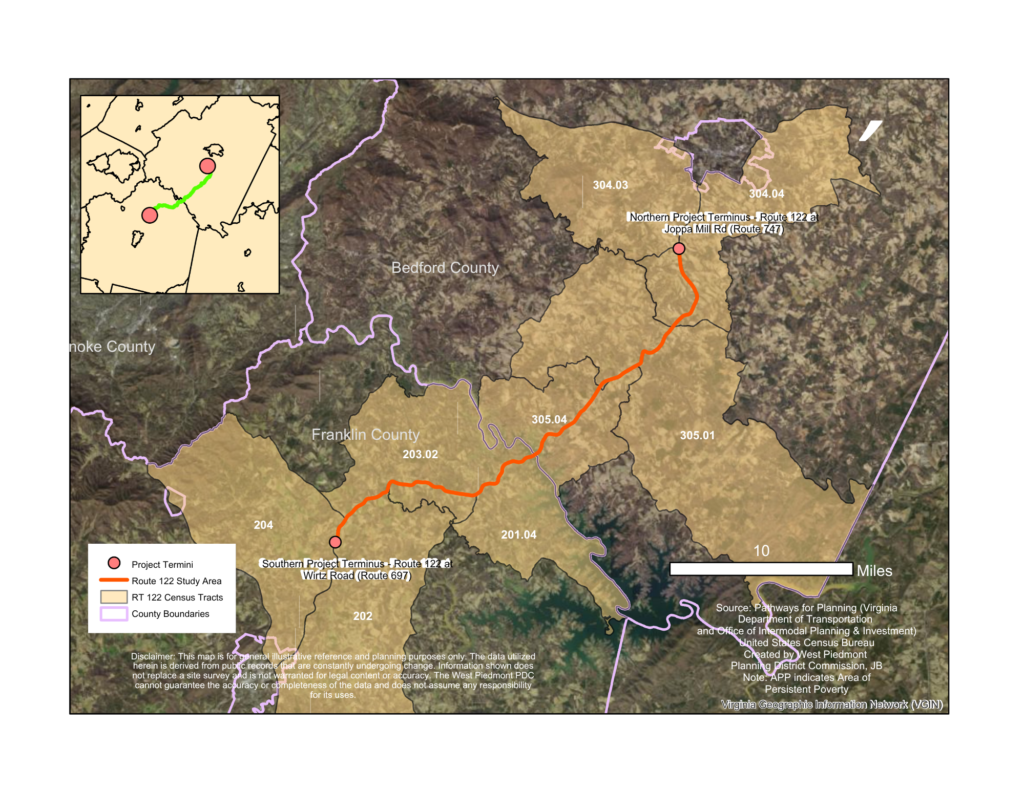
Study area of the Route 122 corridor in Bedford and Franklin counties.
The West Piedmont Planning District Commission (WPPDC), in partnership with Bedford and Franklin counties, is moving forward with the Route 122 Corridor Study, funded by a $1,657,148 RAISE (Rebuilding American Infrastructure with Sustainability and Equity) Grant from the Federal Highway Administration. This regional grant supports the development of a comprehensive study and master plan for the Route 122 corridor—a vital connection for communities in Franklin and Bedford counties and the greater Smith Mountain Lake region.
“The RAISE Grant provides our region a unique opportunity to address transportation challenges and strategically plan for future growth,” said Michael Armbrister, Executive Director of WPPDC. “We are collaborating closely with Bedford and Franklin counties and are committed to engaging the public at every step.”
The Route 122 Corridor Study will focus on the approximately 24-mile stretch from Wirtz Road (Route 697) in Franklin County to Joppa Mill Road (Route 747) in Bedford County. As the primary roadway serving the Smith Mountain Lake resort and retirement community, Route 122 is a critical link between Franklin County in the Roanoke metro area and Bedford County in the Lynchburg metro area. Ongoing growth in the Smith Mountain Lake area continues to put pressure on this rural two-lane route, which was constructed decades ago to serve a smaller population.
“This study is designed to assess both current and future transportation needs along the Route 122 corridor—including safety, capacity, and geometric improvements,” said Joe Bonnano, Senior Planner for WPPDC and project lead. “We are also exploring multimodal options such as a corridor-wide multi-use trail, improved connectivity and redundancy, a potential park-and-ride facility, and shuttle service connections to Amtrak. Importantly, we will build on recommendations from recent and past planning efforts, particularly in the Westlake Corner area, to address limited alternative transportation, corridor redundancy, and land use connections.”
The Route 122 corridor master plan will address a comprehensive range of improvements, including roadway safety and capacity enhancements to enable the corridor to accommodate more vehicles safely, improved connectivity along the corridor, and opportunities for strategically targeted Traditional Neighborhood Development (TND) and mixed-use development—particularly within Westlake Corner, with the potential for replication in other areas. The plan will also emphasize coordination between transportation and land use, incorporate Complete Streets elements in key locations, and explore Transportation Demand Management options such as a park and ride facility with bicycle parking in Westlake Corner. Additional considerations include the development of a micro-transit or shuttle service linked to nearby Amtrak stops, the feasibility of a corridor-wide shared-use path, and recommendations for multimodal continuity across Smith Mountain Lake. The potential need for a secondary bridge span will also be analyzed to ensure redundancy in case one bridge becomes inoperable.
Project activities will begin in fall 2026 and are expected to conclude by October 30, 2028. The first year will focus on data analysis and public engagement to identify corridor needs and deficiencies. In the second year, the team will develop recommendations and strategies for improvements along the entire corridor, with ongoing opportunities for community input.
WPPDC, Bedford County, Franklin County, and the Central Virginia Planning District Commission invite area residents, businesses, and stakeholders to participate in upcoming public meetings and provide feedback as the study progresses. Details on engagement opportunities will be announced as the project moves forward.